Diffractive Gratings: Creating Originals, Masters, and Replication at Scale
What is the process of diffractive grating manufacturing at Omega?
Diffractive gratings are manufactured through a two-stage process: creating an original, high-fidelity master grating (ruled or holographic) and replicating that master to scale. This approach ensures consistent groove structure, high optical efficiency, and repeatable performance across production volumes.
What Are Diffractive Gratings and Why Do They Matter
Diffractive gratings are periodic structures that diffract light into specific wavelengths and play an important role in:
- Spectroscopy / Hyperspectral imaging for astronomy, forensics, medicine
- Telecommunications – wavelength division multiplexing (WDM) for fiber optics, QKD (filtering entangled photons for secure communications)
- Industrial – Laser ablation for parallel processing in semiconductor manufacturing
- Medical Lasers – Shaping a laser beam for treatment use.
- Laser Systems – Pulse compression, wavelength tuning, spectral beam combining, beam steering & focusing
- Quantum Technologies – Quantum simulation, quantum metrology (achieving sub-shot-noise sensitivity for ultra-precise measurements
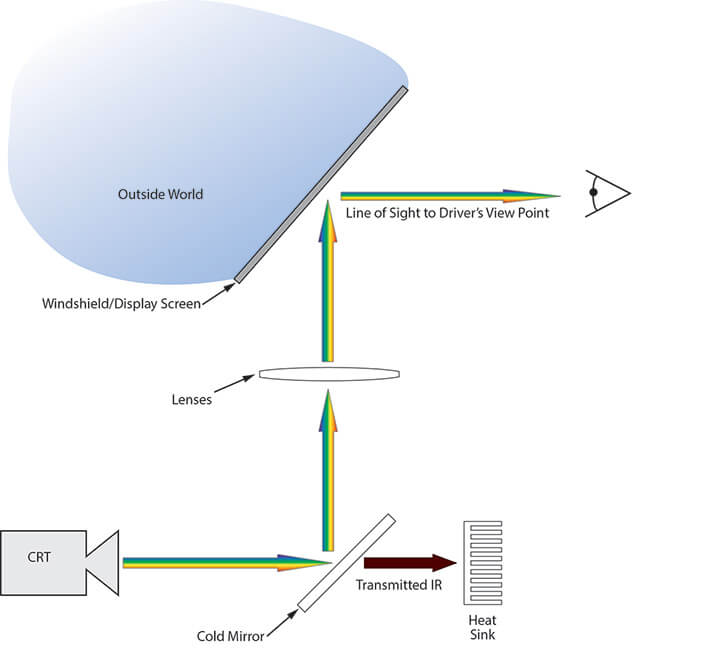
- Automotive Lidar – non-mechanical beam steering, HUD
- Medical Diagnostics – OCT for high-resolution imaging
- Security – creating effects on IDs, CCs and counterfeiting detection
- GRISMs – combined grating and prism functionality – inline spectroscopy
Creating the Master Grating at Omega Optical
Omega’s diffraction gratings allow OEM success through our ability to design custom master solutions and by future-proofing your manufacturing with readily available grating replications.
Custom optical coatings may be added to your RFQ during our initial discussion.
Our massive library of grating masters allows our customers to take full advantage of lower-cost, rapid turnaround replications, which offer incredible accuracy.
As a customer of ours, you also have easy access to our gratings engineering group for answers and custom designs.
“Omega is one of the only companies in the world today with this level of expertise and available facility space, offering ALL 3 solutions of holographic mastering, ruling and replication.”
Omega Custom Ruled Gratings are Differentiated By:
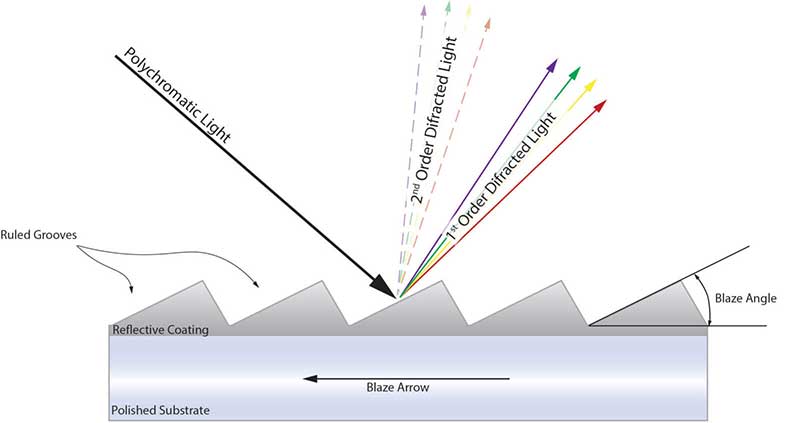
- Mechanically ruled grooves using diamond tools, which offers excellent control over the blaze angle requirement.
- Ruled gratings are best for specific wavelength optimization
Omega Holographics Gratings for Analytical Instrumentation
Holographic gratings offer a multitude of usefulness in instrumentation. Ideal for imaging and low-noise systems, as there is less stray light to manage or control, critical in the detection of weak signals. This is the preferred choice when your application needs a very low scatter, high spectral sensitivity with a smooth groove profile.

Key Engineering Considerations When Selecting Your Grating Requirements
Groove density (lines/mm) is one of the primary selections with gratings as this directly controls how strongly the source light is dispersed, and how your system will balance resolution, wavelength coverage and efficiency.
Blaze angle and wavelength targeting determine your efficiency to perform exactly. Your groove shape is the measure of each groove itself and steers the diffractive light to a specific wavelengths. The blaze wavelength is seen as the sweet spot of your grating. This is where your grating’s diffraction efficiency works at its best. For example, for Raman spectroscopy at 785nm, you would require a blaze near 750-800 nm to maximize a weak signal return for measurement.
Substrate material selection will impact all of your other decisions regarding transmission gratings. Here are some rule of thumb selections:
Common Transmission Grating Materials
– UV (190-400nm) – Fused silica, UV-grade quartz
– Visible (400-700nm) – BK7, Fused silica
Surface quality and uniformity are what determine your “clean, repeatable data” from just diffracting light. We look for the Macro layer for physical flatness, as well as the Micro layer of grooves and roughness for control of your spectral data and low noise. Stray light is the enemy and at Omega, our processes are designed around eliminating stray light in each component.
Master Grating Fabrication At Omega
As the “gold standard” reference optic, master gratings must preserve groove fidelity, surface smoothness and phase accuracy.
What to request for your requirement:
– Custom Original Gratings are required for higher power applications (1KW/cm2) and when the highest degree of flatness (λ/10) is needed.
– A Custom Master Grating is required when off-the-shelf solution does not meet your exact dispersion and resolution design needs.
Once a Master Grating is completed, it can be used to make hundreds of thousands of replicated gratings with incredible accuracy and repeatability. Your Master Grating will be stored in our extensive library, to be used whenever you need to reorder.
Need exclusivity with your design? We can do that as well. Let’s discuss.
Why A Custom Master Matters
Exact groove fidelity, spacing, and depth with the absence of distortion are all requirements of a custom master grating. Any existing errors can be passed down as distortion or degraded data quality and loss of spectral resolution. This is absolutely critical when used in astronomy and other high-resolution systems where light is scarce.
Scalable Production of Replicated Gratings
Standard replicated gratings are produced from ruled and holographic originals and are intended for spectrophotometers, spectrometers and monochromators where low cost, high efficiency and low stray light are of primary concern to systems OEMs.
Since our gratings are created from larger masters, they are ruled over their entire surface, which yields a 90% or better clear aperture.
High-volume manufacturing capability in two of our locations, Littleton, NH and Ayer, MS. We’ve mentioned cost efficiency, but it’s worth mentioning again.
Consistency across replication batches is a result of our process.
1. Fabricate and verify a master grating
2. Apply a release agent to the surface of the master grating
3. Apply epoxy
4. Add the replica substrate
5. Cure the epoxy and release the replica
6. Dice parts to final dimensions
We test for groove fidelity, spectral performance and select added coatings for durability – especially in the UV/DUV ranges.
Performance Considerations in Replicated Gratings
Shifting from master gratings to replicated options, here is our list of areas to discuss during your fact-finding conversation with our gratings experts.
Diffraction efficiency – the resulting replicated groove fidelity
Wavefront quality – substrate flatness before the replication and layer thickness/ uniformity
Stray light suppression – resulting groove smoothness and defects/ coating imperfections
Uniformity and accuracy of groove spacing
Environmental durability & stability – watching for adhesion and thermal expansion issues with material stacks require precise engineering
Polarization effects – noticeable in small deviations inside certain types of coatings & thicknesses
Expectations When Working with Omega Optical
Additionally, our well-documented capability working in the UV range (190–400 nm) and award-winning DeepUV™grating makes Omega a sought after solution house for both UV grating transmission and reflection performance.
Omega Optical combines original design, master fabrication, and replication expertise to deliver diffraction gratings that meet both performance and scalability demands.
Talk with an Optical Engineer About Your Grating Design
Bring your wavelength targets, geometry constraints, and performance requirements to us. Our team will translate your requirements into manufacturable & scalable grating solutions.
What is the difference between ruled and holographic gratings?
Ruled gratings use mechanically cut grooves for high efficiency at specific wavelengths, while holographic gratings use laser interference patterns to reduce stray light and improve imaging performance.
What aspects influence diffraction grating performance?
Performance is influenced by groove accuracy, surface quality, coating durability, and environmental stability.
Can diffraction gratings be customized?
Yes—parameters such as groove density, blaze angle, substrate, and coatings can all be tailored to specific